 PhD Program in Historical studies


Syracuse
 The disastrous earthquake that destroyed Syracuse in 1693 marked a turning point in the history of the cathedral of the city. The bare and austere interior was decorated, probably by Pompeo PicheraliAn architect, painter and engraver from Syracuse, Pompeo Picherali (1670-1743) left his mark on many monuments of his native city, such as the Churches of the Spirito Santo (Holy Spirit), of Santa Lucia (Saint Lucy) and the Virgin of Carmel., with a dense layer of stucco, on a thick layer of plaster. If this stucco work, however, was later removed to restore the cathedral to its previous appearance, other changes introduced over the centuries are still visible. This is the case of the great Baroque altar built by Giovanni VermexioGiovanni Vermexio was the most important member of a family of architects of Spanish origin active in Syracuse. He died in 1648. in 1659 at the behest of Bishop Capobianco, recovering a monolith of the entablature of the ancient Doric temple for the table. Between the columns of the magnificent aedicule is a painting of the Nativity of Mary, while an elaborate gable with jagged edges and a circular frame in the center is located above the entablature. Beyond this and other additions, the interior of the Cathedral of Syracuse still has a simple structure with three naves, marked by strong pillars. On the sides you can see the Doric columns of the ancient temple of Athena, embedded in the wall. The atmosphere is dimly lit by arched windows at the top of the walls.
To introduce the three naves there is a hall, in which there are three portals. The central portal is inserted between twisted columns, with Apulian-inspired tendrils around the stem. In the niches on the side walls there are sculptures of the Dominican Saints Louis Bertrand and Vincent Ferrer.
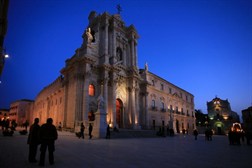
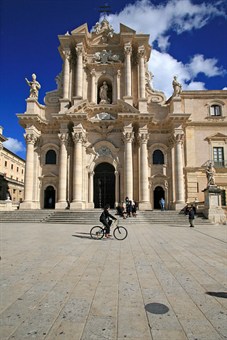 Out of the atrium, the exterior of the building is from after the earthquake of 1693. The Baroque façade was erected between 1728 and 1754 by the architect Andrea PalmaAndrea Palma (1644-1730) was an architect and painter, a native of Trapani. He was active especially in Palermo, where he died, but he also worked in Syracuse and in particular on the façade of the cathedral. from Palermo, the winner of the competition to replace the previous Norman façade. Strong chiaroscuro effects characterize the complex, by alternating projections and recesses and the use of decorative friezes in relief. They help to give depth to the façade with superimposed orders of the two smooth Corinthian columns that vertically divide the prospectus. The columns are detached from the wall, arranged in pairs and on different levels. The coat of arms of Bishop Tommaso Marini, who built the first order, is inserted in a golden eagle (a symbol of Spanish military power), above the entrance. The curvilinear gable with a projecting cornice, placed above the entablature, stops in the middle to make room for a commemorative stone that recalls the work of Bishop Testa, Marini’s successor. Two large spirals which connect the lower order to the higher, were built in the mid-eighteenth century in a more narrow order. It is dominated by the limestone statue of the Virgin Mary, in the central niche, and Saints Lucy and Marziano at each end, all made by the sculptor Ignazio MarabittiIgnazio Marabitti (1719-1797) was a sculptor from Palermo. He had a flourishing workshop and worked in many centres of Sicily, in particular in the cathedral of Syracuse and in the cathedral of Monreale.. The triangular pediment is covered with frames surmounted by the cross, thus accentuating the verticality of the building. Ignazio Marabitti also executed the statues of Saint Peter and Paul on either side of the staircase.
<<<—previous page next page—>>>